See your evidence — don't just search it
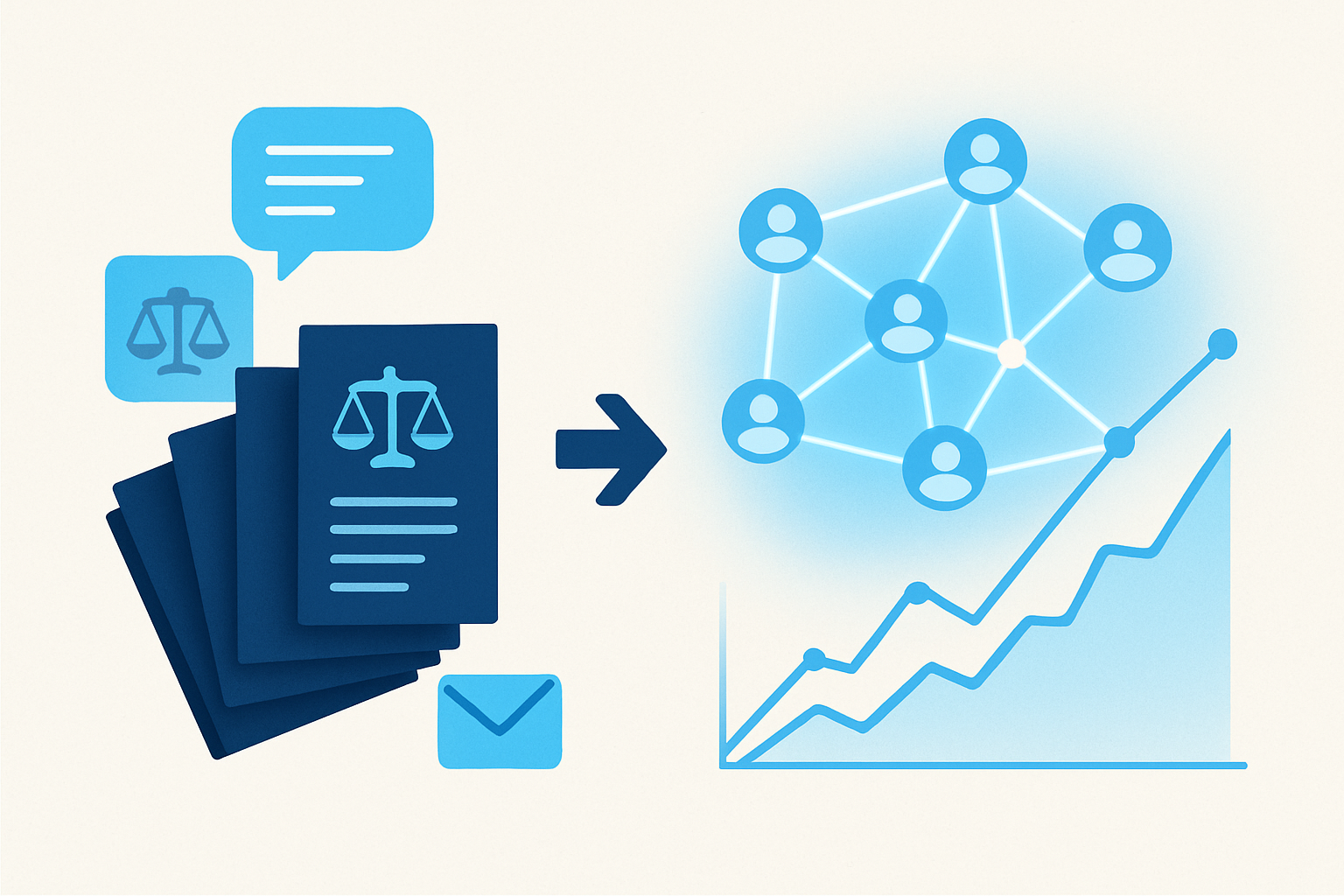
A litigation associate at a fifteen-lawyer firm opens the Slack export opposing counsel just produced: 38,000 messages, two years, nine channels. There's no litigation-support department to hand it to and no e-discovery analyst down the hall — it's her, a legal pad, and the billable clock. Somewhere in that pile are the six messages that decide the motion.
This is what discovery looks like at most small and mid-size firms now. Those communications are squarely discoverable — the federal rules treat electronically stored information, chat and messaging included, as fair game4 — and the data volume that used to belong to big-ticket cases shows up in ordinary ones. But the tooling and headcount that large firms throw at it doesn't scale down to a practice running a handful of active matters at a time. So the work falls back on the people whose hours are the firm's product.
The obvious move is to point an AI at the pile and start asking questions. That helps, but on its own it quietly reproduces the thing that made review hard in the first place: you're still staring at text, one answer at a time, with no way to see the shape of what happened. And in a legal matter, a chatbot that sounds confident is a liability, not a feature.
The tools were built for the other end of the market
Discovery software isn't new — but the established platforms are priced and staffed for large firms: five- and six-figure annual commitments, per-gigabyte processing fees, and a dedicated litigation-support team to actually drive them. For a firm carrying a handful of active matters, that math never closes.
So small and mid-size firms usually fall back on one of two options, and both get worse as the data grows. Ship everything to an e-discovery vendor per matter and eat the per-gigabyte invoice — or review it by hand and eat the hours. The second one quietly costs the most: in RAND's study of large e-discovery productions, attorney review alone accounted for about 70% of the total cost.1 Those hours come straight out of the people whose time the firm actually bills for. What's missing is the middle: the capability a big firm's litigation-support team provides, without the contract and the headcount to match.
A chat window over your evidence isn't enough
Ask a generic AI assistant "when did the tone of this thread change?" or "who was actually driving this decision?" and you'll get a fluent paragraph. What you won't get is something you can defend: a picture of the traffic, with every claim resolving back to the specific message it came from.
Three things go wrong when a chat window is the only interface to your evidence:
- You can't see time. Litigation is a story that changes across dates — who went quiet, when a new name appears, where the volume spikes. A paragraph can't show you that; a timeline can.
- You can't see relationships. "Who talked to whom, and how much" is a network, not a sentence. The custodian who looks peripheral in the document list is often obvious the moment you draw the graph.
- You can't trust what you can't trace. A summary with no citation is a rumor. Every number and every quote has to point back to a producible message, or it doesn't exist.
The fix: see the same evidence several ways
The evidence doesn't change — how you look at it does. One imported set of communications should be viewable as a timeline, as a communication network, and as the raw messages themselves, and you should be able to move between them without losing your place.
This is where a real tool earns its keep. A communication network graph draws every participant as a node, sized by how much they said, and every relationship as a link, weighted by how often they talked — so the person at the center of events stops hiding in a spreadsheet. A timeline shows message volume over hours, days, or weeks, so a sudden spike or a three-week silence becomes visible instead of implied. And every view drills straight down to the underlying message, so what you found is always something you can produce.
Generic AI can't do this part reliably. Ask it to "draw the timeline" and it will describe one, plausibly, sometimes wrongly. Drawing an accurate chart of your evidence isn't a language problem — it's a data problem, and it needs the actual records, computed, not narrated.
Grounded to one matter — and nothing else
There's a second problem that matters even more in legal work, and it's the one that makes most attorneys rightly nervous about AI: leakage. Evidence from one client's matter must never surface in another's. An assistant that quietly "learns" from everything you feed it is a privilege incident waiting to happen.
The answer is scope. The AI's entire world should be the evidence inside the matter you're working — not your other cases, not the open internet, not "general legal knowledge" it might invent. Isolation is the default, not a checkbox you remember to tick.
That single design choice — the AI can only see the evidence in the matter you opened — is what turns AI from a risk you have to explain into a review accelerator you can defend. It also lines up with a lawyer's own duty of technological competence: to use a tool like this responsibly, you have to know it won't wander outside the record.2
How we actually enforce the scope
We didn't rebuild that isolation from scratch inside Legal Discovery. It's powered by a separate app in our platform — our Context Engine, the shared grounding layer the whole mesh runs on. It's the piece that decides, for any given question, exactly which evidence an AI is allowed to see and pulls it back with its source attached. Legal Discovery leans on it so a matter's evidence stays a matter's evidence — the "grounded to one matter" behavior above isn't a feature we bolted on per product, it's the platform doing its job.
This is really a context problem
Step back and the legal-specific worry becomes a general engineering discipline: giving an AI system exactly the right information for the task, and nothing that would mislead it or leak. That discipline has a name — context management — and it's the difference between AI that guesses from the open world and AI that answers from a defined, trusted set of facts.
Matter-scoping is just that idea applied where the stakes are highest. If you want the general version — why grounding and scope decide whether enterprise AI is trustworthy at all — we wrote it up separately: Grounding AI in the right context.
What this means for a small or mid-size firm
Put the two pieces together — see the evidence several ways, scoped to one matter — and it changes the economics of discovery for a firm that doesn't have a litigation-support department:
- The visualizations do the triage a support team used to do. The network graph and timeline point your associates at the handful of custodians and days that matter, so billable review hours go to judgment instead of scrolling.
- No per-gigabyte contract to sign for every matter. You get big-firm evidence intelligence without the big-firm platform commitment or the analyst headcount to run it.
- Privilege stays clean without a compliance apparatus. Matter isolation is built in, so you're not depending on someone remembering a boundary between clients.
- Defensibility your malpractice carrier will like. Every answer traces back to a producible message — no "the AI said so." That traceable, supervised use is exactly what recent ethics guidance expects when lawyers put generative AI near a case.3
What we built
Legal Discovery is the tool we built around exactly these constraints — for the firm that has real discovery to do and no team standing by to do it. You open a matter, import the evidence — Slack exports, email, documents — and the app does two things generic AI can't:
- It shows you the evidence, not just a chat box. Interactive, D3-powered visualizations built from the actual records: a force-directed communication network you can drag and explore, message timelines, activity by hour and day, channel and participant breakdowns — each one clickable straight down to the source message.
- It scopes the AI to the matter. The assistant attached to a matter can see only that matter's imported evidence. Its extractions — names, dates, custodians, counts — are computed from the record and logged against the matter, so there's a trail.
Your associates get to the three messages that decide the case faster, the hours you bill go to lawyering instead of scrolling, and everything you found is something you can put your name on.
If you're a small or mid-size firm with real discovery to do and no litigation-support team to hand it to — let's talk →
Sources
- Nicholas M. Pace & Laura Zakaras, Where the Money Goes: Understanding Litigant Expenditures for Producing Electronic Discovery, RAND Corporation (2012) — attorney review accounted for roughly 70% of e-discovery production costs. https://www.rand.org/pubs/monographs/MG1208.html
- American Bar Association, Model Rules of Professional Conduct, Rule 1.1, Comment [8] — a lawyer's duty of competence includes keeping abreast of the benefits and risks of relevant technology. https://www.americanbar.org/groups/professional_responsibility/publications/model_rules_of_professional_conduct/rule_1_1_competence/comment_on_rule_1_1/
- ABA Standing Committee on Ethics & Professional Responsibility, Formal Opinion 512: Generative Artificial Intelligence Tools (July 29, 2024) — competence, confidentiality, and supervision when using generative AI in practice. https://www.americanbar.org/content/dam/aba/administrative/professional_responsibility/ethics-opinions/aba-formal-opinion-512.pdf
- Fed. R. Civ. P. 34 — production of documents and electronically stored information in discovery (Legal Information Institute, Cornell Law School). https://www.law.cornell.edu/rules/frcp/rule_34
The discipline behind matter-scoped AI — why grounding and scope decide whether enterprise AI can be trusted at all: Grounding AI in the right context →